Autonomous Driving Reaches a Global Inflection Point
The global race for autonomous driving is entering a new phase. While the United States continues to refine its homegrown autonomous technologies, Chinese players are expanding aggressively across Europe and the Middle East. From robotaxis serving passengers in Swiss cities to robobuses operating in Saudi Arabia, the competition to deploy self-driving fleets is accelerating faster than many predicted.
Chinese tech firms like Baidu, WeRide, and Pony.ai are moving early, launching pilot programs and local partnerships that give them a head start over US rivals. At the same time, companies such as Waymo and Tesla remain largely focused on the North American market, fine-tuning their systems and testing infrastructure before expanding globally.
This moment marks a clear divergence: China is scaling deployment abroad while the US is optimizing at home. The next five years will determine which approach wins the race to commercialize autonomous mobility worldwide.
Scaling Autonomous Driving: China and the United States Take Different Paths
Autonomous Driving in the United States
In the US, Waymo remains the most commercially advanced autonomous ride-hailing service. Its fleet now provides more than 250,000 paid rides per week across Austin, Phoenix, and San Francisco. The company’s sensor-rich robotaxis integrate lidar, radar, and computer vision to navigate complex city environments with high precision.
Waymo’s expansion is accelerating. While its first rollout in Phoenix took nearly four years, the company now launches new cities in as little as 14 months. Cruise, once a major competitor, has effectively exited the market after safety and regulatory setbacks, leaving Waymo as the clear industry leader.
Tesla follows a different path. Its vision-based autonomous system relies solely on cameras and AI rather than lidar or radar. The company’s Full Self-Driving software remains a supervised Level 2+ system that still requires driver oversight. Tesla has launched supervised ride-hailing pilots in Austin and the San Francisco Bay Area, but these are not open to the public for paid rides.
Despite CEO Elon Musk’s ambitions, Tesla’s dedicated robotaxi network remains in the planning stage. The company’s focus on scalability and cost-reduction over redundancy places it on a separate trajectory from sensor-heavy approaches like Waymo’s.
China’s Rapid Domestic Expansion and Commercialization
Mainland China’s autonomous driving sector has advanced rapidly, supported by strong government incentives, clear regulatory frameworks, and abundant real-world data.
Baidu Apollo, Pony.ai, and WeRide are operating robotaxi and robobus pilots in major cities such as Beijing, Guangzhou, and Shanghai. These projects are expanding from small-scale trials into full commercial operations. Several operators already charge passengers for fully driverless rides within designated zones.
Baidu’s Apollo Go fleet has become one of the largest robotaxi networks in the world, serving cities such as Wuhan and Shenzhen. WeRide and Pony.ai have introduced autonomous robobuses for short-distance urban routes, a move that addresses city transit shortages while providing valuable data for large-scale rollout.
China’s national strategy aligns technology, infrastructure, and regulation in a coordinated system, creating an ecosystem that nurtures rapid testing and deployment.
US and Chinese Autonomous Vehicle Leaders Target Europe and the Middle East
As domestic markets mature, both US and Chinese autonomous vehicle companies are expanding abroad. However, the approaches differ sharply.
While US firms such as Waymo and Tesla focus on refining operations at home, Chinese companies are moving quickly into emerging regions, leveraging export-ready platforms and strategic partnerships in Europe and the Middle East.
Autonomous Driving Pilots Across Europe
Europe has become a major proving ground for autonomous driving technology. Regulatory harmonization across France, Germany, Luxembourg, and Switzerland is accelerating the rollout of pilot projects.
Mobileye, an Intel subsidiary, plays a leading role as a technology provider. It is partnering with automakers and transit agencies to deploy autonomous shuttles, including ongoing passenger trials in Hamburg, Germany. Fully driverless services are expected by 2026.
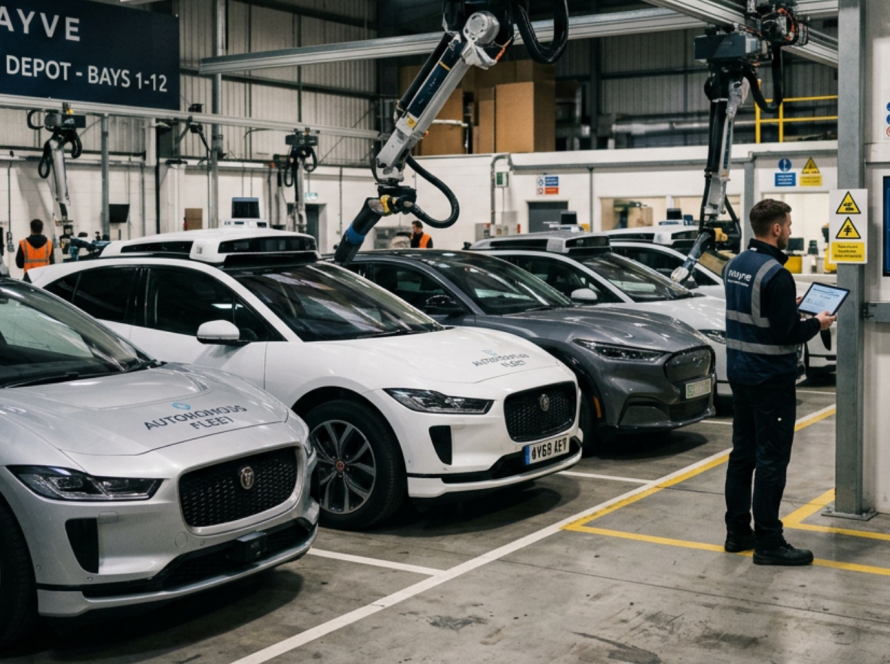
UK-based Wayve is testing its AI-driven vehicles on public roads in several British cities, using camera-only systems designed for complex urban settings.
Turkey’s ADASTEC, working with OEM Karsan, has successfully deployed its Level 4 autonomous robobus, the Karsan e-ATAK, across Finland, Germany, the Netherlands, and Norway. These buses already operate in airport and city environments, offering practical demonstrations of reliability in real-world conditions.
Chinese companies like Baidu, Pony.ai, and WeRide are also expanding into Europe. Baidu plans to start operations in Switzerland and Turkey, followed by broader EU markets. Pony.ai’s pilot in Luxembourg aligns closely with EU safety and data standards.
Robobuses are proving particularly effective in Europe, where they complement existing public transport. Their fixed routes and lower technical requirements make them easier to deploy in busy cities, reducing last-mile congestion and supporting municipal transit networks.
Autonomous Vehicles in the Middle East
The Middle East is becoming one of the most promising frontiers for autonomous vehicles. Saudi Arabia and the United Arab Emirates are leading the charge, building smart city infrastructure that enables large-scale deployment of autonomous fleets.
Chinese companies such as WeRide, Baidu, and Pony.ai have already established pilot operations in Abu Dhabi and Riyadh. Supported by sovereign wealth funds and partnerships with major mobility platforms like Uber, these initiatives benefit from strong government backing and favorable policies.
Tesla and Waymo have not yet entered Middle Eastern markets. Tesla’s vehicles remain Level 2+ systems, while Waymo has chosen to focus on US operations before tackling international regulations.
This creates an early-mover advantage for Chinese autonomous firms, which are positioning themselves as the default technology partners for local governments seeking to modernize transport infrastructure.
What’s Driving Autonomous Vehicle Demand in Europe and the Middle East
Europe: Policy and Urban Pressures
European cities are under pressure to cut emissions, reduce congestion, and modernize public transport. Autonomous vehicles fit naturally into these goals, especially when integrated with Mobility-as-a-Service (MaaS) platforms that combine multiple modes of transport within a single user experience.
Labor shortages in the transportation sector and rising operational costs in countries such as Switzerland and the UK make automation attractive. Robobuses, operating on predictable routes, can supplement existing transit systems without requiring extensive redesign.
In the freight sector, companies like Mercedes-Benz and Volkswagen are pursuing Level 4 autonomy for trucks and vans, while Mobileye’s long-haul partnerships signal a shift toward autonomous logistics within the next decade.
Middle East: Smart Cities and Strategic Investment
Middle Eastern nations are integrating autonomous driving into their smart city visions. Saudi Arabia’s NEOM project and the UAE’s Dubai Autonomous Transportation Strategy both aim to make autonomous mobility a key pillar of their economies.
These countries combine financial power with flexible regulation, enabling rapid experimentation. Even without domestic automotive manufacturing, they are attracting international partnerships to develop localized autonomous solutions.
Robotaxis and robobuses fit perfectly into this ecosystem, offering mobility services that can function efficiently in high temperatures and across vast, well-planned urban grids.
Opportunities and Challenges for US and Chinese Autonomous Leaders
Europe and the Middle East offer huge commercial potential but present distinct challenges.
The opportunities lie in strong government support, investment incentives, and urban mobility needs. Early entrants can secure multi-year contracts with transit authorities and position themselves as trusted technology partners.
However, European regulations are complex. Data protection laws such as the General Data Protection Regulation (GDPR) restrict how companies collect and store geospatial data, creating compliance hurdles for foreign operators. Localized data centers, transparent security protocols, and joint ventures with European partners are becoming essential for market entry.
Chinese firms must also navigate geopolitical sensitivities and public perception challenges, while US firms must overcome regulatory delays at home to compete internationally. Success will depend on operational transparency, local partnerships, and a deep understanding of regional ecosystems.
The Future of Autonomous Driving in Europe and the Middle East
Europe and the Middle East are fast becoming the proving grounds for global autonomous driving. Both regions combine strong policy frameworks with a growing appetite for technology-driven mobility.
For now, Chinese companies hold a clear early-mover advantage. Their integrated industrial approach, government alignment, and robust data ecosystems enable rapid expansion. But as US players like Waymo, Tesla, and Mobileye refine their systems and regulations evolve, competition will intensify.
The next phase of autonomous mobility will not be defined by technology alone but by trust, transparency, and regional collaboration. Those who can combine technological excellence with regulatory alignment and social acceptance will shape the roads of the future.