Global investment in autonomous vehicles has surged to a record $21.4 billion in 2026, marking a more than threefold increase compared to the full year 2025. The funding was distributed across just 34 deals through mid-April, signaling a significant shift in capital allocation strategies within the mobility technology sector.
For C-level executives, the trend reflects a clear transition from broad-based startup funding to concentrated investments in category-defining leaders.
Capital Concentration Around Market Leaders
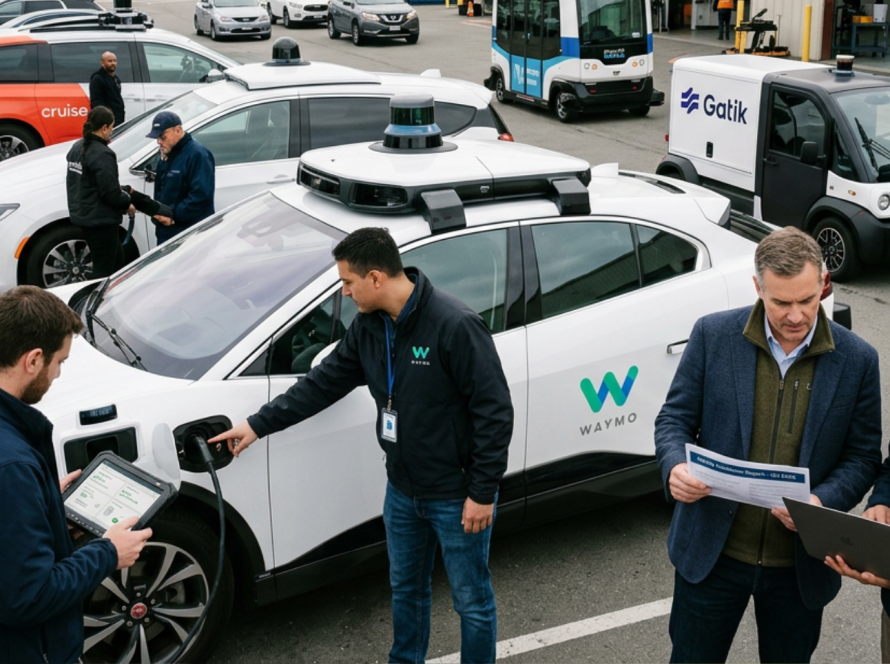
A dominant share of the autonomous vehicle funding 2026 cycle was driven by a single major transaction. Waymo raised $16 billion in a Series D round in February, valuing the company at $126 billion and accounting for roughly three-quarters of total sector funding.
Additional large-scale investments included multibillion-dollar rounds for Shield AI and Wayve, reinforcing investor preference for established or high-confidence platforms.
This concentration indicates a strategic repositioning of capital toward fewer but more dominant players expected to define the long-term autonomous mobility landscape.
Shift in Investor Strategy
The funding pattern highlights a structural change in venture and growth-stage investment behavior. Rather than distributing capital across a wide range of early-stage startups, investors are increasingly focusing on a small set of companies with proven technology, scalability, and regulatory traction.
Key characteristics of this shift include:
- Fewer but significantly larger funding rounds
- Emphasis on technological maturity and deployment readiness
- Preference for platforms with global scalability potential
For decision-makers, this signals a maturing market transitioning from experimentation to consolidation.
China’s Rapid Deployment Advantage
While the United States continues to dominate capital formation, China is emerging as a leader in real-world autonomous vehicle deployment.
Chinese startups are increasingly capturing significant funding rounds and simultaneously accelerating commercial rollout across urban mobility, logistics, and transport applications. This dual advantage of capital access and deployment speed is shaping global competitive dynamics in the autonomous mobility sector.
Implications for the Autonomous Mobility Ecosystem
The record funding cycle has several strategic implications:
- Market Consolidation: The industry is moving toward a few dominant global platforms
- Capital Efficiency: Investors are prioritizing scale-ready technologies over early-stage experimentation
- Geopolitical Competition: The US and China are diverging in strategy-capital concentration vs. rapid deployment
- Commercial Acceleration: Increased funding is expected to speed up real-world adoption timelines
Conclusion: A Market Entering Its Consolidation Phase
The surge in autonomous vehicle funding to $21.4 billion marks a defining moment in the evolution of the sector. The focus is no longer on proving feasibility, but on scaling established platforms capable of global deployment.
For C-level executives, the message is clear: the autonomous mobility market is entering a consolidation phase where leadership will be determined by scale, capital efficiency, and deployment capability-not just innovation.